
There was a time when spotting a fake dating profile was simple. The warning signs were familiar: grainy stock photos, oddly phrased bios, and professions that sounded suspiciously glamorous. But in the age of artificial intelligence, deception has evolved. What once looked clumsy and obvious is now disturbingly convincing. The faces staring back at users on dating apps – warm smiles, perfect lighting, and “authentic” imperfections – may not belong to any real person at all. They are the creations of algorithms, designed to charm, manipulate, and ultimately deceive.
The digital age of romance has always danced on the edge of illusion. Profiles are carefully curated, photos are filtered, and stories sometimes stretch the truth. Yet, today’s landscape has shifted beyond embellishment into full-blown fabrication. Scammers have begun to exploit AI tools that generate ultra-realistic faces, images that can pass casual scrutiny and even fool seasoned moderators. The result is a new breed of romance scam, one that blends emotional manipulation with technological sophistication.
From stolen selfies to synthetic souls
Before the AI boom, online romance scams followed a predictable formula. Fraudsters would steal photos from real people’s social media accounts, spinning tales of love, loss, or longing to lure unsuspecting victims. When victims reported these profiles, platforms could trace the stolen images and remove them. But with AI-generated faces, the game has changed completely.
The technology behind these synthetic profiles is astonishingly advanced. Generative AI can now produce faces that look indistinguishable from genuine photographs. Each image is unique, making reverse-image searches useless. There’s no original photo to trace, no real person to identify – just pixels synthesized from millions of data points, trained to mimic human features down to the smallest detail.
As Bloomberg’s investigation “Scammers litter dating apps with AI-generated profile pics” revealed, entire networks of these artificial identities are spreading across major dating platforms. Some are used for traditional romance scams, where emotional bonds are forged to extract money or information. Others serve more subtle goals: spreading misinformation, conducting social engineering, or promoting scams unrelated to romance at all.
In short, the fake faces of today are not stolen; they’re manufactured. And that makes them far harder to catch.
Love, lies, and algorithms
Imagine you’re scrolling through your favorite dating app. You stop at a face that seems perfect: kind eyes, a friendly smile, and that intangible “realness” that draws you in. You start chatting. The conversation flows easily, perhaps a bit too easily. The person seems available, interested, emotionally intelligent. What you don’t know is that every image you’ve seen and every carefully chosen word has been engineered to appeal to you.

AI isn’t just generating pictures; it’s helping craft entire personas. Large language models can now simulate personalities, preferences, and emotional responses. Combined with generative visuals, scammers can create complete digital humans who never existed but behave as if they do.
This growing overlap between generative AI and human relationships is already being studied by organizations such as the Partnership on AI, which notes that synthetic personas are reshaping how people connect online.
Victims often describe the experience as emotionally intense. They form genuine attachments, confide personal details, and invest emotionally – all with a digital ghost. When the truth emerges, the damage extends beyond financial loss. There’s a deep sense of betrayal and humiliation that comes from realizing you’ve fallen in love with an algorithm.
Why traditional detection fails
Most dating platforms rely on manual moderation or simple automated filters to flag suspicious accounts. These systems are effective against the obvious offenders: duplicate photos, spammy bios, or inconsistent data. But AI-generated faces are a different beast.
An AI photo has no digital footprint – it doesn’t exist anywhere else online. Reverse-image search tools like Google Images or TinEye can’t find a match. Even advanced moderation teams can be deceived because these AI photos include subtle details that mimic real photography, such as natural lighting variations, tiny skin imperfections, and reflections in the eyes.
In some cases, scammers intentionally degrade these images slightly, for example adding blur, filters, or compression to make them look even more believable. Ironically, the slight “imperfection” of a low-resolution image can make it seem more authentic to the human eye.

The result is a perfect storm: images that fool both algorithms and people. For dating platforms trying to maintain user trust, this is a growing crisis. And for users seeking genuine connections, it’s an emotional minefield.
A new kind of catfishing
Catfishing i.e. pretending to be someone else online to deceive others – isn’t new. But “AI catfishing” represents a new level of sophistication. These aren’t just imposters hiding behind someone else’s identity; they are inventing new identities from scratch.
Some scammers even use AI-generated profile videos, where deepfake technology animates static faces to speak or blink naturally. These moving images are especially convincing during video calls, blurring the line between real and fake. In other cases, scammers use voice-cloning tools to simulate live conversations, creating the illusion of a real person on the other end of the call.
These AI-driven tactics turn dating apps into arenas of deception, where the face you’re falling for may have been built in seconds by a machine.
The emotional and financial toll
The financial losses from romance scams are staggering. In 2023 alone, global reports estimated billions of dollars lost to fraudulent online relationships. Yet, the emotional cost is even higher. Victims often struggle with self-doubt and shame, questioning their ability to trust again.
A recent industry survey found that many online daters in the UK have already encountered AI-generated scam profiles, often suffering both financial losses and emotional distress.
AI intensifies this emotional harm because the deception feels so personal. The “person” they connected with isn’t just a random scammer hiding behind someone else’s photo. It’s a carefully engineered persona designed to be irresistible. Victims often describe these synthetic interactions as eerily tailored to their preferences, as if the scammer knew exactly what they wanted to hear. In many cases, they did: through data analysis, language modeling, and pattern recognition.
Fighting back with AI-image detection
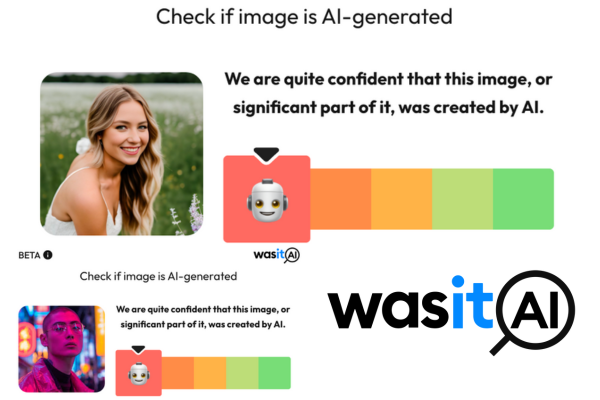
If AI created the problem, perhaps AI can also be part of the solution. Dating platforms are beginning to explore technologies that can detect when an image has been generated by a machine rather than captured by a camera. That’s where services like WasItAI come in.
WasItAI helps platforms automatically verify whether profile photos are human-made or AI-generated. By integrating this technology, dating apps can screen new profiles at the upload stage – identifying synthetic images before they reach users. Unlike traditional moderation, this kind of detection looks beneath the surface, analyzing digital signatures and pixel patterns that reveal telltale signs of AI generation.
Beyond detection, such technology empowers platforms to build trust. When users know that their potential matches have been verified as real people, they feel safer and more willing to engage authentically. It’s not just about stopping scams, it’s about preserving the integrity of digital intimacy.
Restoring trust in digital love
The future of online dating depends on trust. Users must believe that the people they meet – whether for friendship, love, or companionship – are real. Without that foundation, the entire premise of digital matchmaking collapses.
By adopting AI-image verification tools, dating platforms can shift from reactive moderation to proactive protection. Instead of waiting for users to report suspicious behavior, they can prevent fake profiles from ever appearing in the first place.
And for users, this technological safeguard doesn’t just protect their wallets; it protects their hearts. It restores a sense of confidence that love online can still be genuine, even in a world where algorithms can imitate it perfectly.
The new reality of romance
AI has reimagined romance, and not always for the better. What began as a technology for creativity and connection has become a tool for deception and manipulation. But it doesn’t have to stay that way.
The same intelligence that generates fake faces can help us detect them. The same innovation that fuels scams can be repurposed to build safer, more authentic digital communities.
Dating apps stand at a crossroads: embrace AI responsibly or risk letting the illusion take over. By implementing solutions like WasItAI’s detection technology, they can take a stand for authenticity, ensuring that behind every smile on their platforms, there’s a real human story waiting to unfold.