
Most shoppers don’t realize how much of their online experience is already fake. A glowing review might not come from a human. A stunning product photo may never have seen a camera lens. The influencer promoting a new gadget may not exist at all. Generative AI has quietly crept into the very fabric of e-commerce, reshaping what consumers see and trust. What appears polished and credible may be nothing more than a simulation designed to look authentic. As shoppers navigate this new visual and textual landscape, the question becomes not just what to buy – but what to believe.
Fake Reviews in E-Commerce: When Generative AI Writes the Story
Reviews have traditionally been the cornerstone of online purchasing decisions. Consumers treat them as a form of collective judgment, a decentralized form of truth that compensates for the inability to inspect products physically. But that trust is under threat. AI-written reviews no longer resemble the repetitive spam of past years; they are increasingly nuanced, emotion-aware, and tailored to product categories in ways that human writers might struggle to match at scale.

Investigations, including recent reporting by CBS News, have shown how sellers now use generative AI to flood listings with manufactured enthusiasm. The reviews are not merely positive; they feel textured, authentic, and conversational. They include anecdotes, comparisons, and purchasing motivations that mimic real buyer experiences. A single operator can now populate a new product with hundreds of fabricated reviews in a matter of hours, creating an illusion of legitimacy that pushes the item higher in search rankings.
This the stage for an even more concerning development: the manipulation of imagery.
AI-Generated Product Images: When Visuals No Longer Guarantee Reality
Product photography has long been considered the most reliable signal in the retail experience. While descriptions can exaggerate and reviews can be inconsistent, images speak directly to a shopper’s visual intuition. People tend to believe photographs instinctively. Fraudsters understand this, which is why generative AI imagery has become their most useful tool.
E-commerce scams no longer need stolen or poorly edited photos. They can now rely entirely on AI-made visuals that portray idealized versions of products – even products that never existed. Generative AI models produce lighting, textures, shadows, and material properties that appear completely natural. They can simulate fabric weave, metal reflections, and background environments with a level of precision that fools even trained designers.

Some deceptive sellers use this capability to exaggerate product quality, smoothing fabric, sharpening resolution, or adding structural details that do not exist in reality. Others generate full product catalogues for items that will never ship. The result is a retail environment where visual reliability, once the backbone of online decision-making, is disintegrating.
Synthetic Influencers: The New Frontier of Retail Deception
Beyond reviews and product visuals lies a more insidious problem: AI-generated influencers. These personas are not deepfakes of real people, nor are they animated avatars. They are fully synthetic individuals with photorealistic faces, carefully constructed personalities, and curated online personas. They post “daily life” content, appear to test products, and share recommendations that look indistinguishable from human endorsements.
For fraudulent sellers, synthetic influencers are the perfect marketing assets. They never age, never demand payment, and can be cloned into multiple identities that target different audience segments. For consumers, this creates a world where even the people offering advice may not exist, a subtle but effective decline of the social credibility that influencer marketing relies on.

This trio – fake reviews, fake images, fake personas – forms a self-reinforcing ecosystem of deception. Each element validates the others, creating a convincing illusion of authenticity that is extraordinarily difficult for consumers to notice.
In one illustrative case, influencer Maggie McGaugh deliberately purchases from sellers using glossy, AI-generated images. The contrast between what is advertised and what she actually receives is often striking – highlighting a growing trend of “too-good-to-be-true” listings.
Generative AI E-Commerce Fraud: A Multilayered System That Works Against Consumers
While generative AI continues to bring legitimate benefits to retail, such as streamlining content creation and assisting customer support, its misuse is reshaping the economics of trust. Authentic sellers suffer when consumers lose confidence in the category. Cart abandonment increases as shoppers question whether the item shown is real. Customer support teams spend more time clarifying whether a product matches its photos. And brands that have spent years cultivating credibility find themselves competing with synthetic operations that appear more polished and engaging.
The sophistication of this deception grows faster than platform moderation systems can adapt. Review filters are not designed to counter AI-driven linguistic variability. Image detection systems cannot reliably identify the subtle distortions and diffusion-model signatures hidden in synthetic visuals. Influencer verification processes are not equipped to distinguish between a real content creator and a fabricated digital persona.
In short, generative AI has outpaced the traditional tools of e-commerce integrity.
Why AI Content Detection Matters
To counter this escalation, retailers increasingly turn toward AI content detection tools, such as WasItAI, that analyze whether a product image, review, or influencer photo has been generated or manipulated by AI. While text analysis is a more mature field, visual authenticity verification is becoming essential. Retailers need ways to determine which images contain AI-generated elements, which ones have been altered, and which are entirely fabricated.
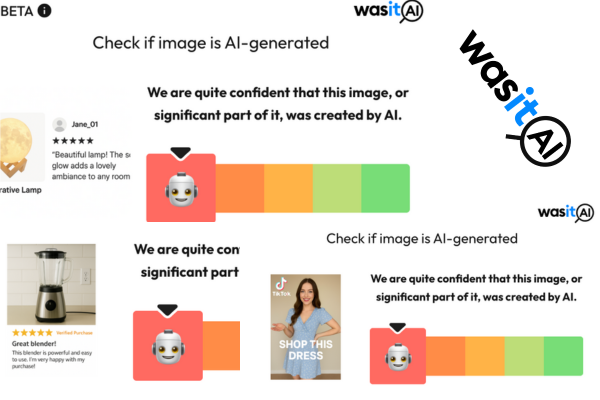
The image layer is the foundation of e-commerce trust. Reviews can be moderated and influencers can be vetted, but without dependable visuals, the entire decision-making process collapses. Shoppers rely on images to evaluate color, texture, scale, and quality. When these visuals are compromised, everything else loses its grounding.
By incorporating AI-image detection into their workflow, retailers can weed out deceptive visuals before they reach consumers. This restores integrity to product pages, improves buyer confidence, and protects brands from reputational damage caused by misleading content, whether posted intentionally or generated by third-party sellers.
The Future of E-Commerce Will Depend on Authenticity, Not Quantity
E-commerce is entering a phase where content volume matters far less than content authenticity. Retailers who embrace transparency, verify their visual assets, and invest in content integrity will set themselves apart in a crowded marketplace. Generative AI is not going away, and its dual nature, as both a creative tool and a vector for deception, demands a more protective approach.
The brands that thrive in the next decade will be those that make authenticity a core value rather than an afterthought. As online shopping becomes increasingly shaped by AI-generated text and imagery, trust will become the ultimate differentiator. And the path to that trust begins with a critical step: understanding and intercepting the image-based misuse that now sits at the center of generative-AI e-commerce fraud.